If you want to rank higher on Google and get more calls coming in, one of the smartest things you can do is study the businesses that are already doing it well. Competitor analysis for SEO is not about copying what someone else is doing. It is about understanding why certain businesses show up at the top of search results and using that information to build a stronger strategy for your own website.
At Blume Agency, competitor analysis is one of the first things we do when we take on a new client. Before we write a single page of content or make a single change to a website, we want to know who is winning in that market and why. That research shapes everything that comes after it, from the keywords we target to the pages we build to the content strategy we put in place. The benefits of competitor analysis for SEO are real and measurable, and this post is going to walk you through exactly what those benefits are and how they apply to your business.
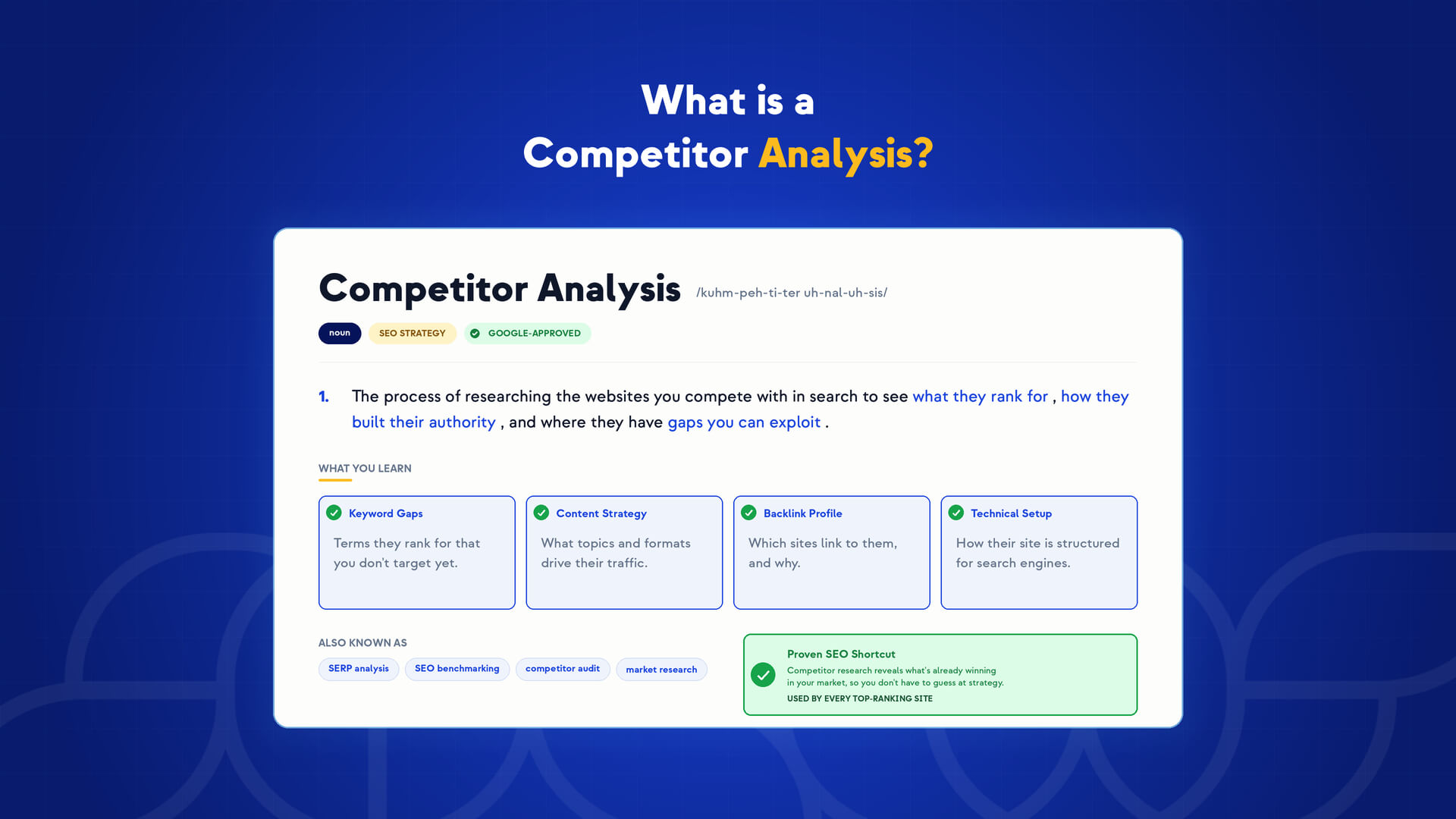
What Is Competitor Analysis for SEO?
Competitor analysis for SEO means looking closely at the businesses ranking above you in Google search results and figuring out what they are doing to earn those positions. It is not just about knowing who your competitors are. It is about digging into the specifics of their websites, their content, their backlinks, and their local presence to understand what is driving their rankings.
For a home service business, this usually starts with identifying who shows up on page one for the searches that matter most to you. If you are a plumber in Charlotte, you want to know which other plumbing companies are showing up when someone types “plumber Charlotte NC” or “emergency plumber near me.” From there, you look at what those businesses have on their websites that you do not, where they are getting links from, how many reviews they have, what pages they have built out, and how their content is structured.
This is not guesswork. There are real tools and a real process behind it, and the information it surfaces directly informs every decision made about your SEO strategy going forward.
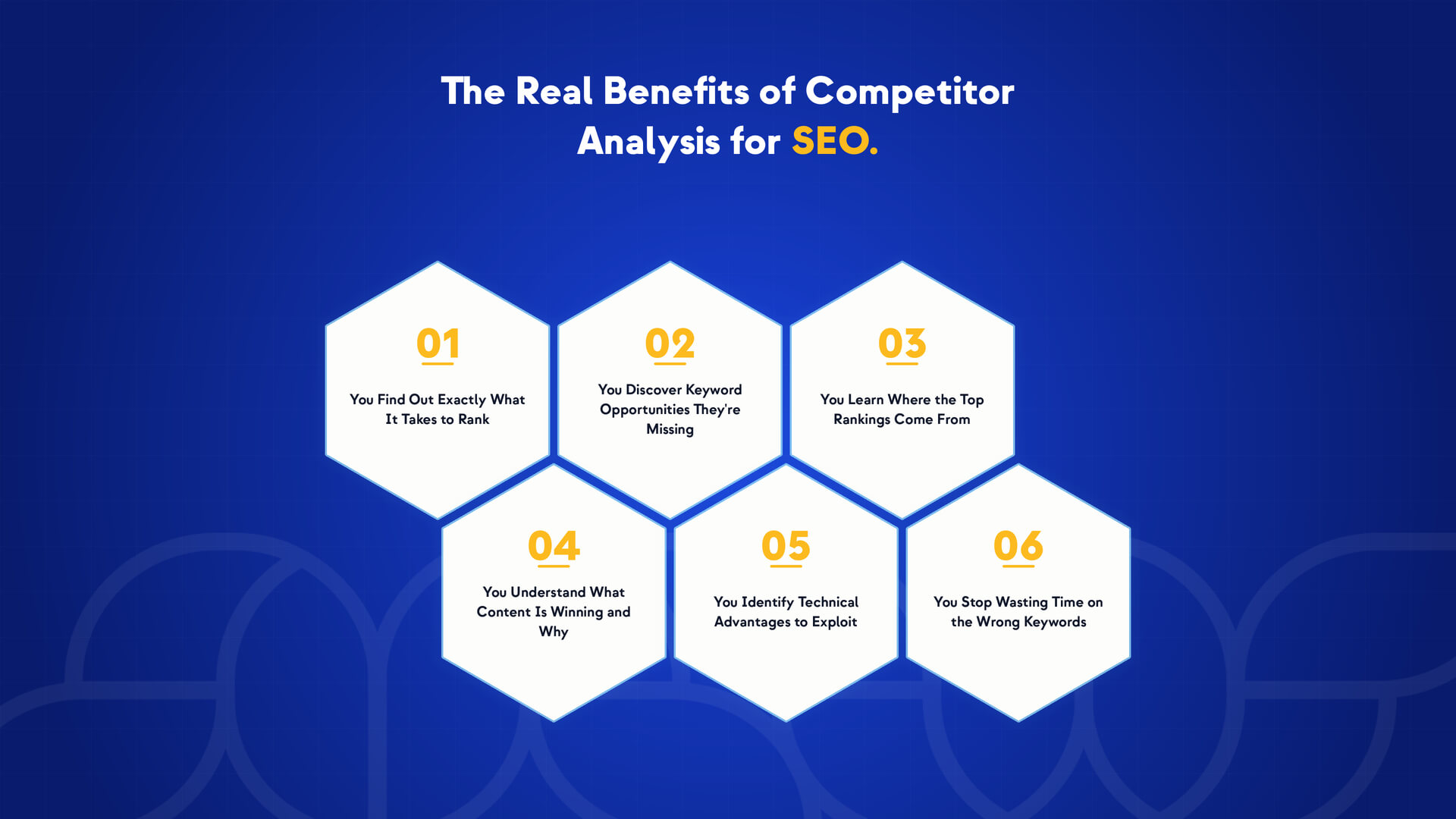
The Real Benefits of Competitor Analysis for SEO
You Find Out Exactly What It Takes to Rank in Your Market
Every local market is different. The effort it takes to rank on page one for HVAC services in a small town is very different from what it takes in a major metro area. Without doing competitor analysis, you are essentially guessing at what the standard is. With it, you know.
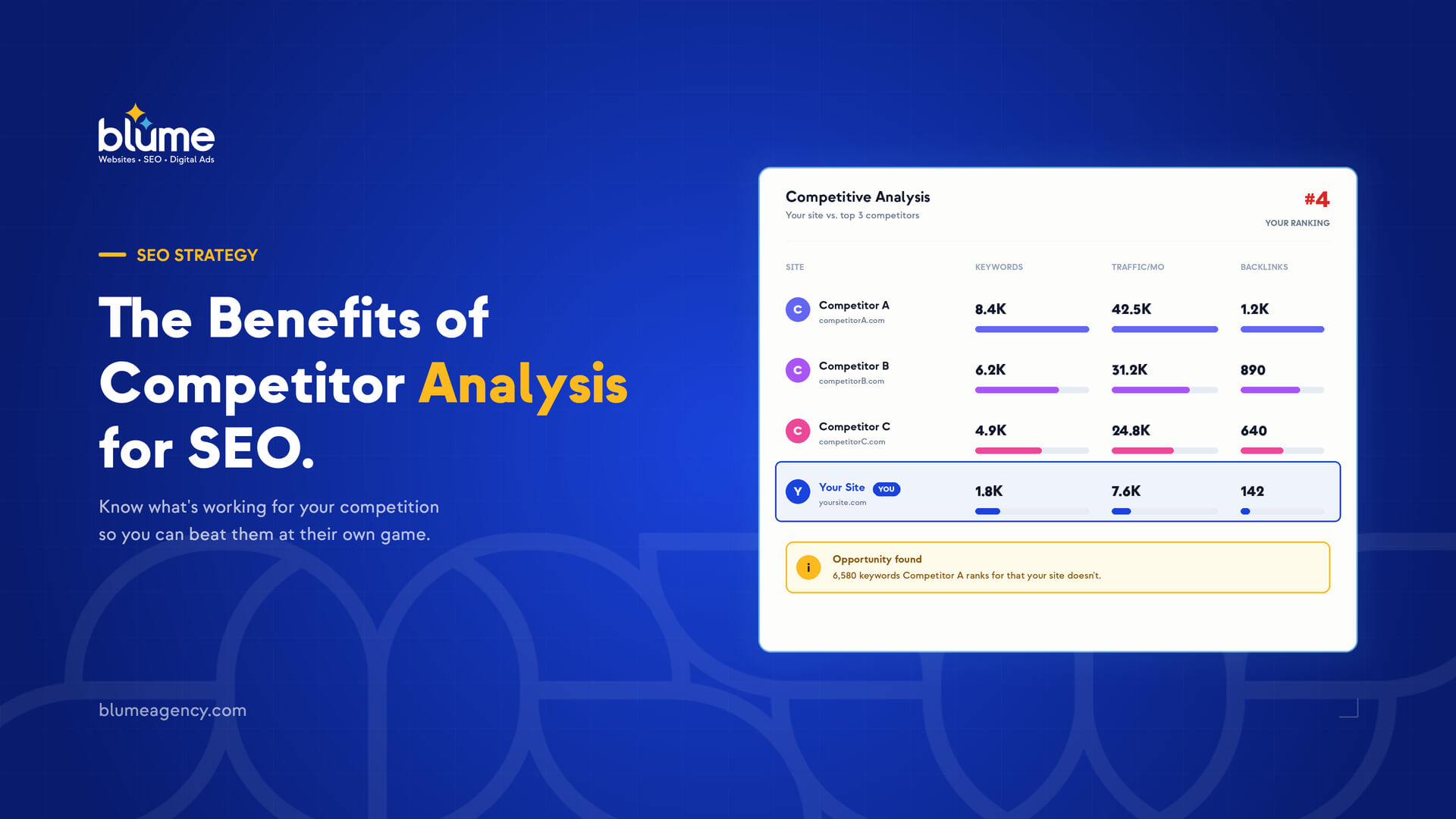
When Blume audits the top-ranking competitors in a client’s market, we can see how many pages their sites have, how their content is structured, how many quality backlinks they have built up, and how well their location pages are developed. That gives us a clear picture of the bar your website needs to clear to compete seriously. Rather than building a strategy based on general best practices alone, we build it around the specific reality of your market.
You Discover Keyword Opportunities Your Competitors Are Missing
This is one of the most valuable benefits of competitor analysis for SEO that most business owners do not think about. When you analyze the keywords your competitors are ranking for, you sometimes find gaps where no one is doing a good job of targeting a specific search. Those gaps are opportunities.
Say the top three HVAC companies in your area all have strong pages for “AC installation” but none of them have a real page targeting “mini split installation.” If that is a service you offer and people in your area are searching for it, building a well-optimized page for that term puts you in front of a search that your competitors are essentially ignoring.
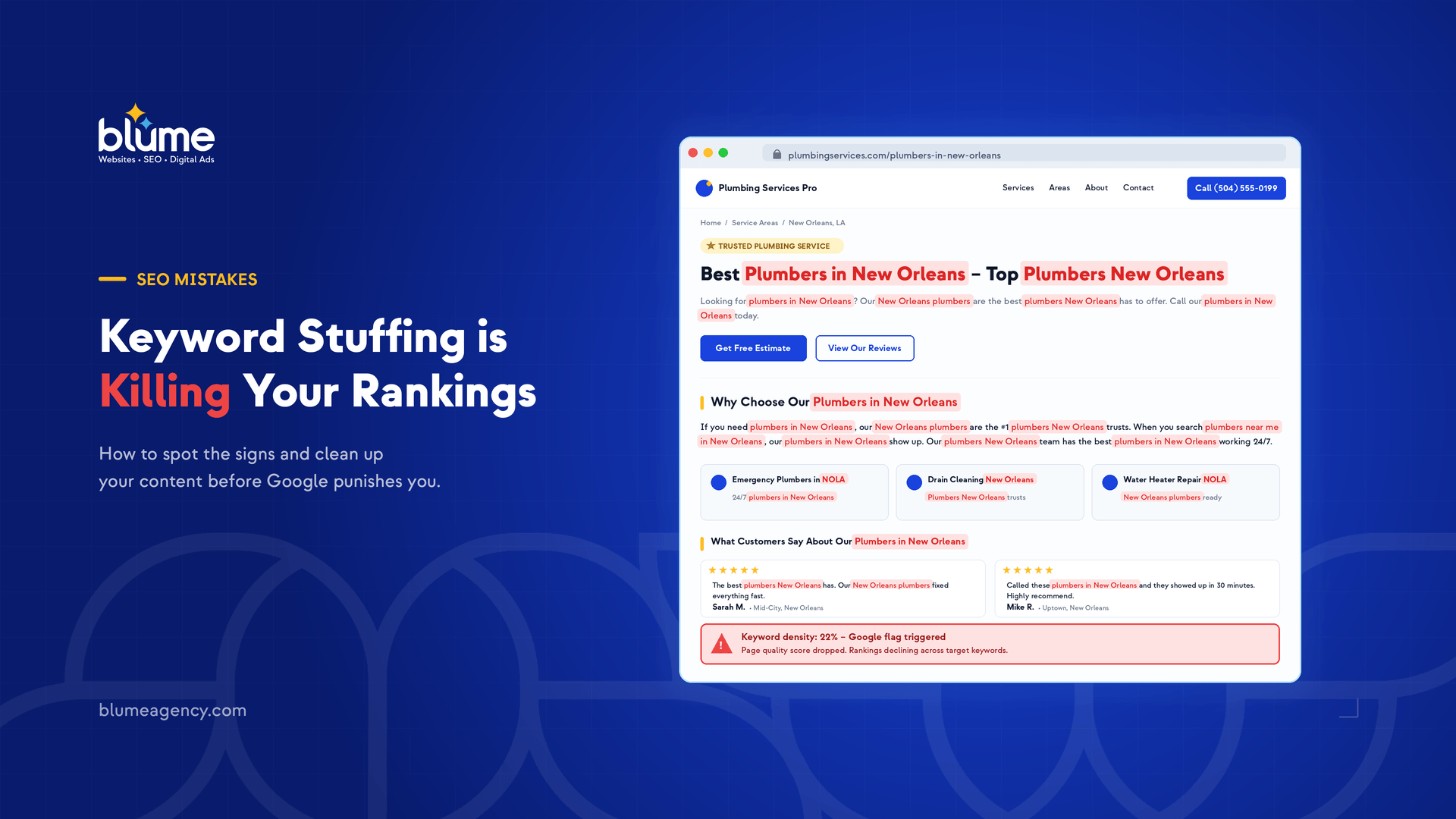
Finding and filling those gaps is a faster path to additional rankings than trying to outcompete established businesses on their strongest keywords right out of the gate. One thing to watch for when reviewing competitor pages is how they are actually using those keywords. A surprising number of businesses still stuff their target phrases into their pages at an unnatural rate, which actually works against them. If a competitor is doing that, their rankings are more fragile than they appear. Our post on why keyword stuffing is killing your rankings explains exactly why that approach backfires and what to do instead.
You Learn Where the Top Rankings Are Coming From
Google uses backlinks as one of its most important ranking signals. When a credible website links to yours, it tells Google that your site is worth paying attention to. Competitor analysis lets you see which websites are linking to your top competitors, which gives you a roadmap for your own link building efforts.
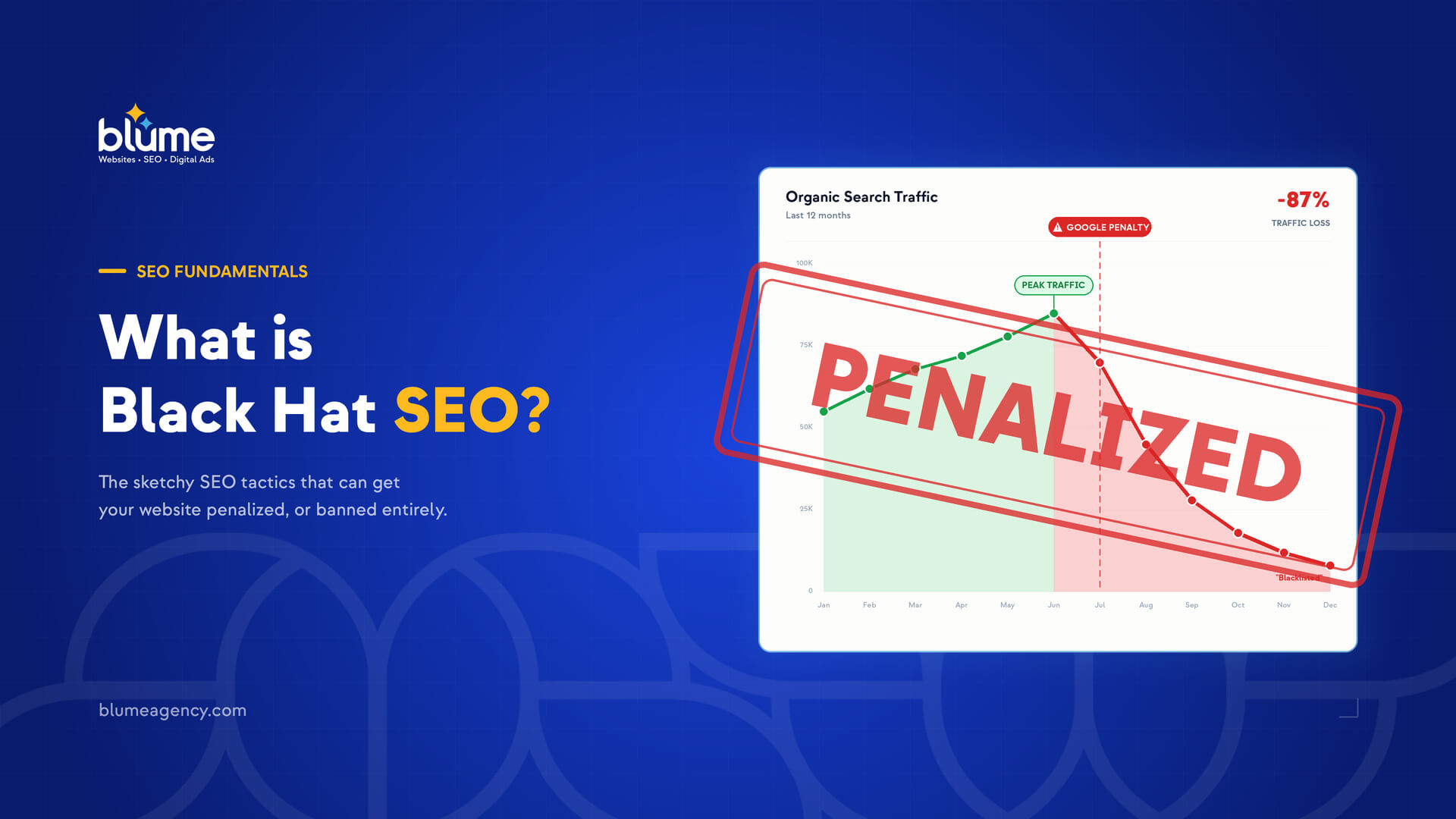
If several of the top-ranking contractors in your market have links from local business directories, industry associations, or local news sites, those are exactly the kinds of places you should be targeting for your own links. Rather than building a link strategy from scratch, you are working from a proven model of what is already driving results in your specific market. It is worth noting that not every link a competitor has is worth chasing. Some businesses have built their rankings on low-quality or purchased links, which is a form of black hat SEO that can result in a Google penalty. Competitor analysis helps you tell the difference between links worth earning and tactics worth avoiding.
You Understand What Content Is Winning and Why
The pages ranking at the top of Google for your most important searches are there for a reason. Competitor analysis helps you understand what that reason is. Maybe the top-ranking competitor has a very detailed service page that answers every question a customer might have before calling. Maybe they have a strong blog that covers topics their customers are searching for. Maybe their location pages are more thorough than anyone else in the market.
Understanding what is working in terms of content gives you a clear direction for your own content strategy. You are not writing pages and hoping they rank. You are building content that you know is competitive because you have studied what the standard looks like in your market.
As Google’s SEO Starter Guide points out, creating content that genuinely serves the people searching for it is the foundation of good search performance. Competitor analysis helps you understand what that looks like in your specific market rather than in the abstract.
You Can Identify Technical Advantages You Can Exploit
Sometimes a competitor is ranking well despite having an outdated or technically weak website. That is actually good news for you, because it means their rankings are vulnerable. If your site loads faster, is better structured, and is more mobile-friendly than theirs, you have a real opportunity to outrank them over time even if they currently hold the top spot.
On the flip side, if a competitor has a technically strong website, knowing that upfront helps you prioritize getting your own technical foundation right before focusing on other parts of the strategy. Blume builds custom websites for home service businesses with technical SEO built in from the ground up, so this is never an area where our clients are starting from behind.
You Stop Wasting Time on the Wrong Keywords
Without competitor analysis, a lot of businesses spend time and money trying to rank for keywords that are either too competitive to realistically win in the short term or not actually driving customer calls. Studying what your competitors are targeting, and more importantly what they are not targeting, helps you prioritize the keywords that give you the best return for your effort.
For a newer website or a business just starting to invest in SEO, this is especially important. Rather than going head-to-head immediately with a competitor that has been building their online presence for ten years, a smart competitor analysis will surface realistic opportunities where you can gain traction faster and start seeing results sooner.
Competitor Analysis and Your Location Pages
One area where competitor analysis pays off in a very direct way for home service businesses is in understanding how competitors are approaching local search. Specifically, which cities and towns are they targeting with dedicated location pages, and how well built are those pages?
A lot of businesses assume their competitors have everything figured out. In practice, even the top-ranking contractor in a market often has gaps in their location page coverage. Maybe they have strong pages for the main city but nothing dedicated to the surrounding suburbs. Maybe their location pages exist but are thin and poorly written.
That is a real opportunity. If you can build better, more thorough location pages for the cities your competitor is ignoring or underserving, you can start capturing searches they are missing entirely.
This is a big part of why we put so much emphasis on a proper Areas We Serve strategy. We covered how these pages work in detail in our post on how Areas We Serve pages help you show up in search results, and competitor analysis is often what tells us exactly where the location page gaps are in a given market.
When Blume audits a client’s competitive landscape, we are not just looking at what keywords competitors rank for. We are looking at which cities they have pages for, how those pages are built, and where the openings are for a client to step in and capture local searches that are currently going to someone else.
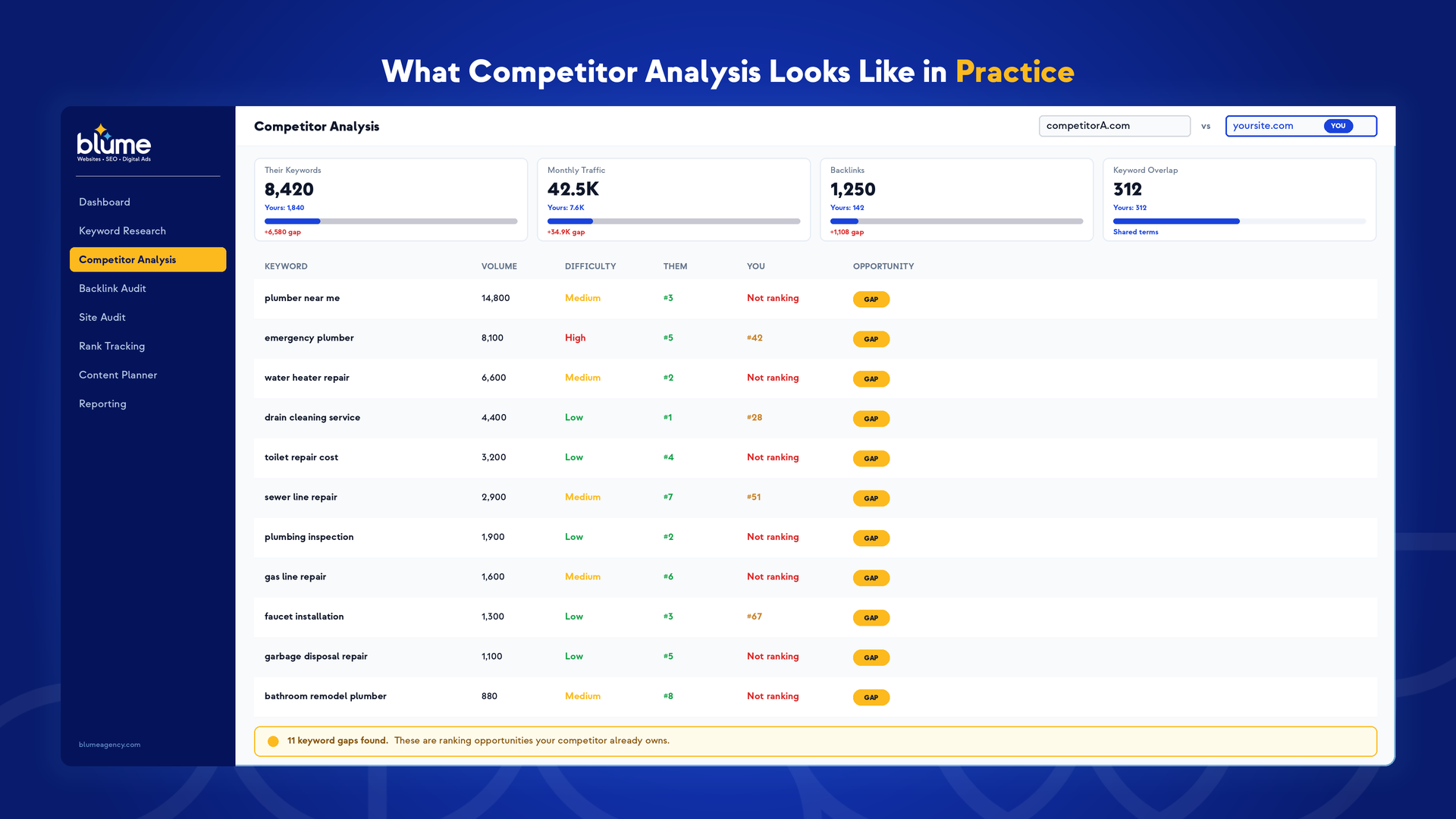
What Competitor Analysis Looks Like in Practice
Here is a simplified version of what Blume actually does when we run competitor analysis for a new client.
We start by identifying the top five to ten businesses showing up on page one for the most important searches in a client’s market. These are the businesses we treat as the benchmark. They are doing something right, and we want to know exactly what that is.
From there, we look at the structure of their websites. How many pages do they have? Do they have dedicated service pages? How thorough are their location pages? Is their site organized in a way that makes it easy for Google to understand what they do and where they do it?
Next, we look at their content. What are they writing about? How long and detailed are their service pages? Are they running a blog, and if so, what topics are they covering? Content depth is often one of the clearest differentiators between a business ranking on page one and one stuck on page three.
After that, we look at their backlink profile. Where are their links coming from? Are they getting listed in local directories? Do they have links from industry organizations or local media? This gives us a clear starting point for building a link strategy that is grounded in what is actually working in that specific market.
Finally, we look at their Google Business Profile presence, their review count and rating, and any patterns in the way they present their business locally. All of that feeds into the complete picture of what it takes to compete in that market.
The output of that process is a clear, specific strategy built around what we know works rather than general assumptions about what good SEO looks like.
Real Results Built on Real Research
Competitor analysis is not a standalone tactic. It feeds into every other part of an effective SEO strategy. The results Blume has produced for home service businesses are grounded in this kind of research-first approach.
Paine Excavating saw a 216% increase in leads after Blume rebuilt their digital presence with a strategy informed by a thorough understanding of their competitive market. Knowing what the competition was doing, and where they were falling short, was a direct input into the strategy that produced those results.
HUDCO Roofing saw a 190% increase in leads after a full overhaul that included competitive research as a foundational step. Understanding the landscape helped us prioritize the right keywords, build out the right pages, and position their website to capture searches their competitors were not effectively targeting.
Duggan’s AC and Heating added more than 220 booked jobs after Blume rebuilt their SEO strategy from the ground up. Competitor analysis was part of what told us exactly where to focus first to start generating results as quickly as possible.
These are not outcomes you get by guessing. They come from understanding the specific market a business operates in and building a strategy around what the data actually shows.
How This Fits Into Blume’s SEO Services
Competitor analysis is built into what Blume does across all of our SEO engagements. Whether a client is just getting started or is looking to push past a growth plateau, understanding the competitive landscape is always one of the first steps.
Our SEO services are built around generating real leads for home service businesses, not chasing vanity metrics. Competitor analysis is one of the key tools that keeps our strategies grounded in what actually moves the needle rather than what looks good on a report.
Paired with Google Ads management, competitor research also informs how we position paid campaigns. Knowing which keywords competitors are bidding on, where they are spending their ad budget, and where there are openings helps us build paid campaigns that are as efficient as possible from day one.
We serve home service businesses across the country. You can see the full list of markets on our areas we serve page, and you can see the full breakdown of what each service level includes on our packages page.
FAQ: Competitor Analysis for SEO
How often should competitor analysis be done?
A thorough competitor analysis should be done at the start of any new SEO engagement. From there, revisiting it every six to twelve months makes sense because the competitive landscape shifts over time. Competitors improve their websites, new businesses enter the market, and search trends change. Staying current on what your competition is doing helps you stay ahead of it.
What if my competitors have much larger websites than mine?
Larger does not always mean better. A bigger website with a lot of thin or poorly written pages is often beatable by a smaller site with well-built, focused pages. Competitor analysis helps identify specifically where the gaps are, and in many cases those gaps exist even for the businesses with the biggest online presence in a market.
Do I need to do this myself or can Blume handle it?
Blume handles all of this as part of our SEO engagements. You do not need to know how to use SEO tools or interpret backlink data. That is what we are here for. What we need from you is a clear picture of your service area, the services you offer, and the goals you have for your business. We handle the research and translate it into a strategy.
Can competitor analysis help me with Google Ads too?
Yes. Knowing which keywords competitors are bidding on and how their ads are positioned helps us build paid campaigns that avoid the most expensive and competitive terms when there are more efficient options available. It also helps identify terms that competitors are missing entirely, which can be a real advantage in paid search just as in organic.
What if all my top competitors are large national companies?
This is actually more common than you might think for certain trades. The good news is that national companies often have weak local SEO because they are trying to rank everywhere at once rather than focusing on your specific market. A locally focused strategy with strong location pages and a well-built Google Business Profile often outperforms national competitors in local search results, even if those companies have larger overall web presences. If you want to understand the full picture of what local SEO can do for a service business, our post on the benefits of local SEO is worth a read.
How long does it take to see results after a competitor-informed SEO strategy is implemented?
Most businesses start seeing meaningful movement in three to six months, with results continuing to build over time. The benefit of starting with solid competitor research is that the strategy is focused on the right things from day one rather than spending the first few months figuring out what to prioritize.
Is competitor analysis the same as copying a competitor’s strategy?
Not at all. The goal is to understand what is working in your market so you can build something better, not to replicate what someone else has already done. Competitor analysis identifies the standard you need to meet and the gaps you can fill. What you build from there is your own strategy, built around your business, your services, and your service area.
Wrapping It Up
The benefits of competitor analysis for SEO are straightforward. It tells you what the standard is in your market, where the opportunities are, what content is winning and why, and where the gaps are that you can step into ahead of your competition. For home service businesses competing in local search, that kind of informed strategy is a significant advantage over businesses that are building their SEO based on guesswork.
At Blume Agency, we do not skip this step. Every client we work with gets a strategy grounded in a real understanding of their competitive market, and that research feeds into everything from their website structure to their location pages to their content plan. If your business is not showing up where it should be in local search results, the answer usually starts with understanding who is showing up and why.
We work with contractors, plumbers, roofers, HVAC companies, and other home service businesses across the country, and we know what it takes to compete in local search. If you are ready to build a strategy backed by real data, we are ready to get to work. Let’s Blume.