If you have ever hired someone to do SEO for your business and later found out your website dropped off Google entirely, there is a decent chance you were a victim of black hat SEO. Or maybe someone pitched you a deal that sounded too good to be true, promising page one rankings in thirty days for a suspiciously low monthly fee. That kind of offer almost always comes with a catch, and the catch can cost you far more than you saved.
At Blume, we work with home service businesses that are trying to grow their online presence the right way. Part of that work involves educating business owners on what to watch out for, because the SEO industry has more than its share of people willing to cut corners at your expense. Understanding what black hat SEO is, how it works, and why it backfires so badly is genuinely useful knowledge for any contractor or service business owner trying to make smart decisions about their digital marketing.
So let’s get into it.
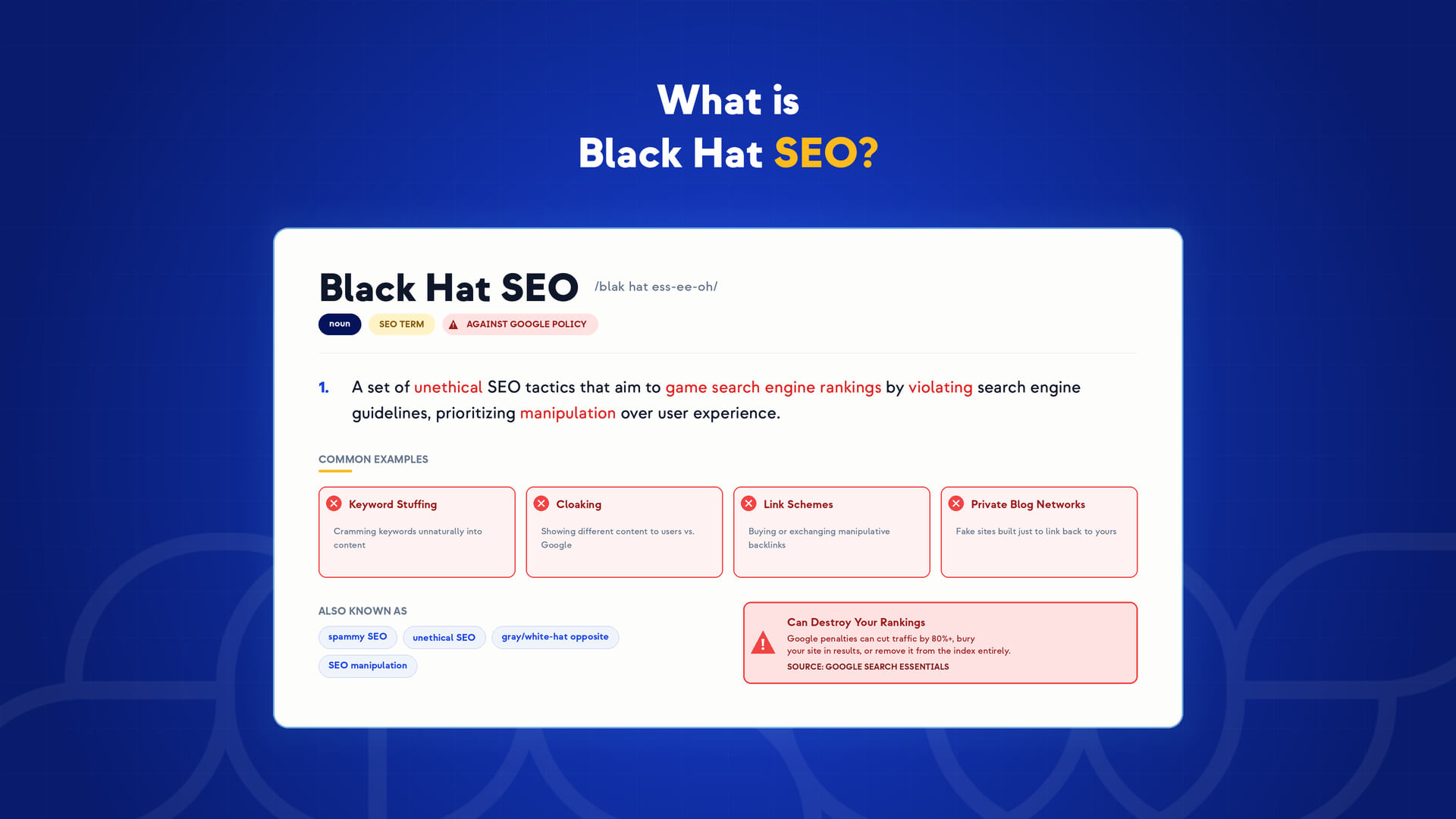
What Is Black Hat SEO?
Black hat SEO refers to a set of tactics designed to trick search engines into ranking a website higher than it deserves. Rather than earning rankings by creating genuinely useful content and building a credible online presence, black hat tactics try to manipulate Google’s algorithm through shortcuts that violate its guidelines.
The name comes from old Western movies where the villain wore a black hat. In the SEO world, it is a straightforward label for the bad guys who cheat the system. The opposite approach is called white hat SEO, which is the practice of building rankings through legitimate, sustainable methods that follow Google’s rules.
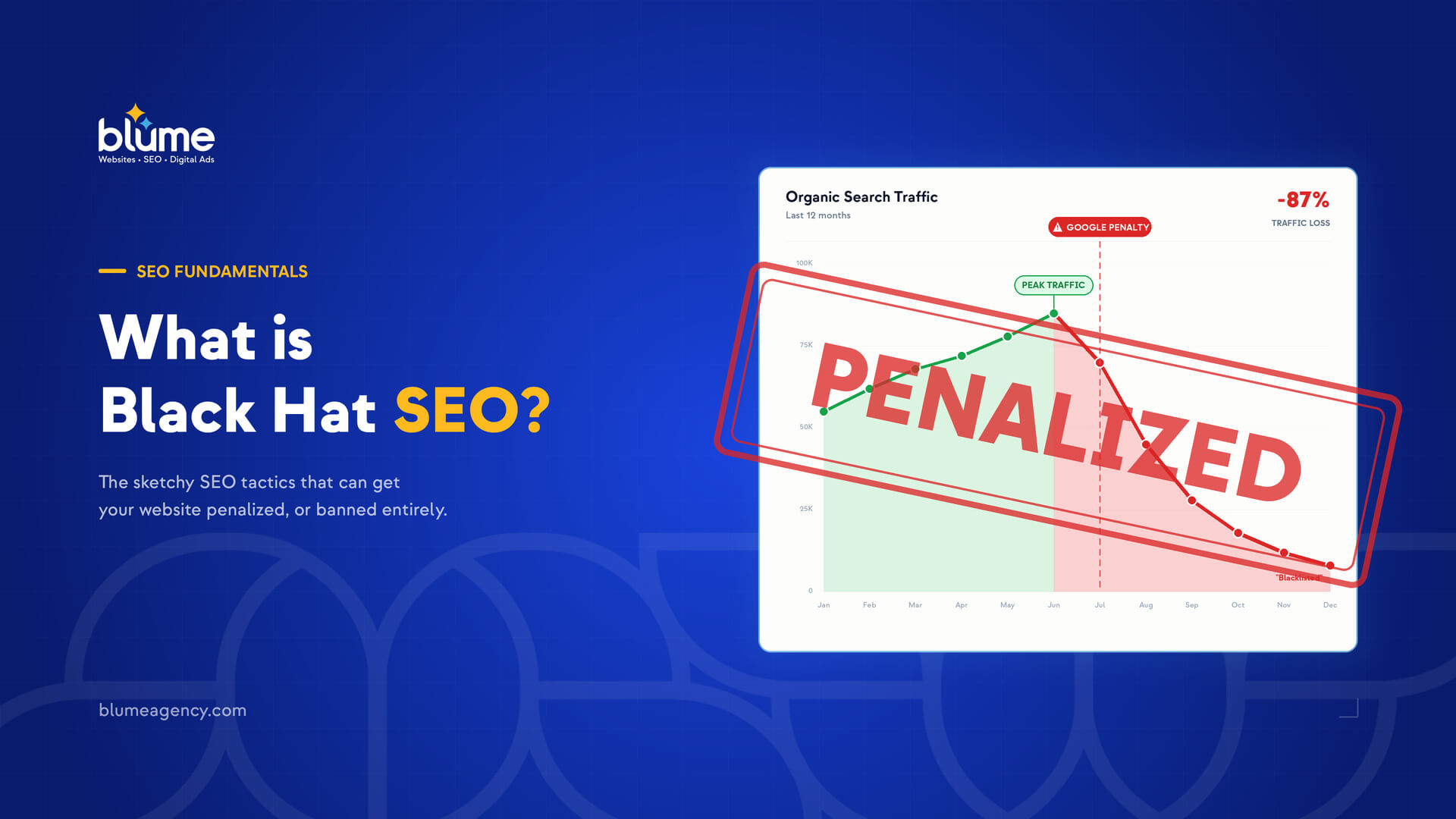
Black hat SEO tactics can work in the short term. That is actually part of what makes them dangerous. A business owner might hire someone using these methods, see rankings jump quickly, and think everything is going great. Then, a few months later, Google rolls out an algorithm update or assigns a manual reviewer to the site, and the rankings disappear overnight. In some cases, the website gets deindexed entirely, which means it does not show up in Google search results at all, not even for the business’s own name.
Recovering from that kind of hit is slow, expensive, and sometimes impossible. And the business owner is often left holding the bag while the person who ran those tactics has already moved on to the next client.
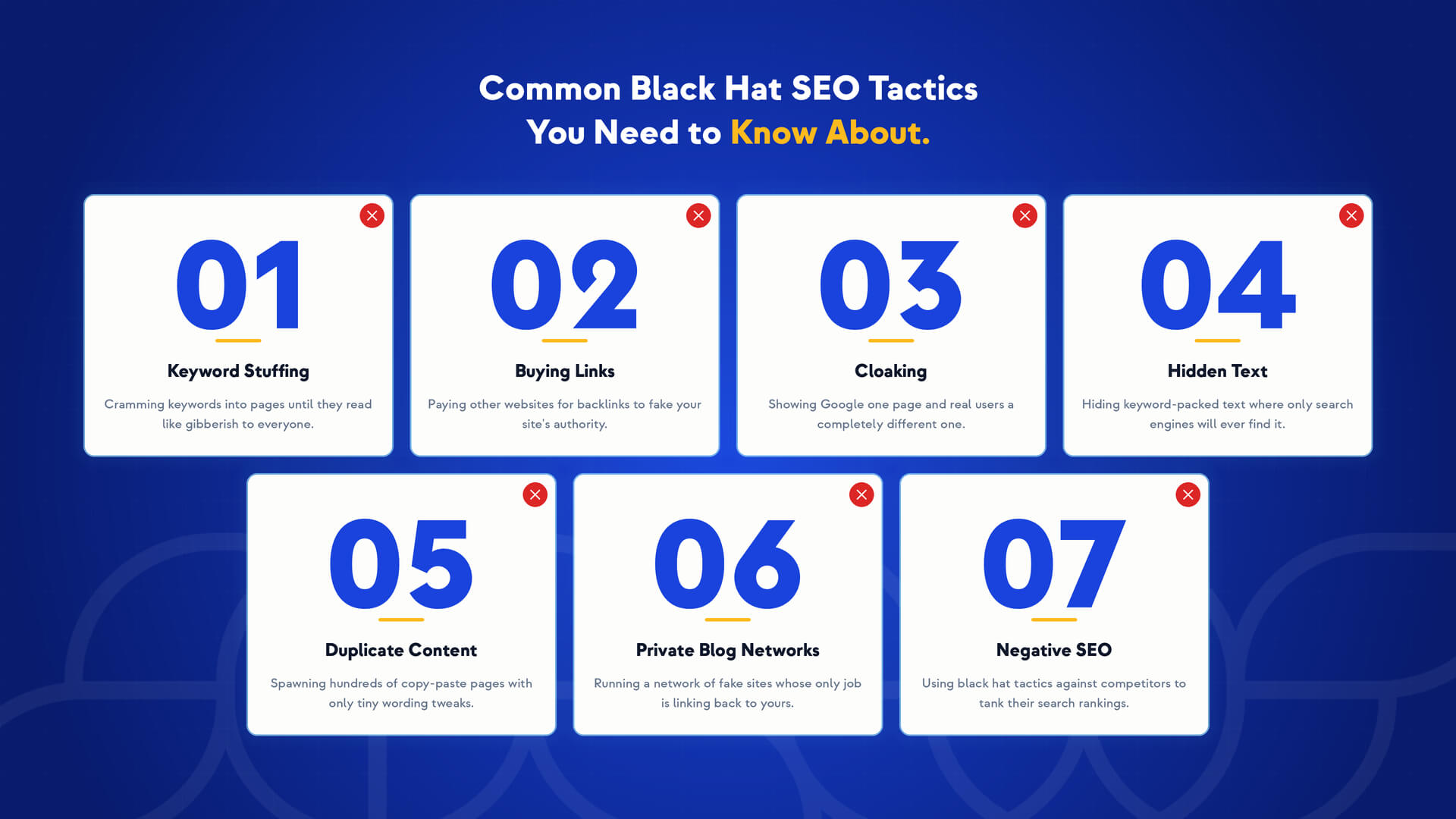
Common Black Hat SEO Tactics You Need to Know About
There are quite a few specific practices that fall under the black hat category. Some of them are obvious once you know what to look for, and others are easy to miss if you are not paying close attention to what is happening on your own website.
Keyword Stuffing
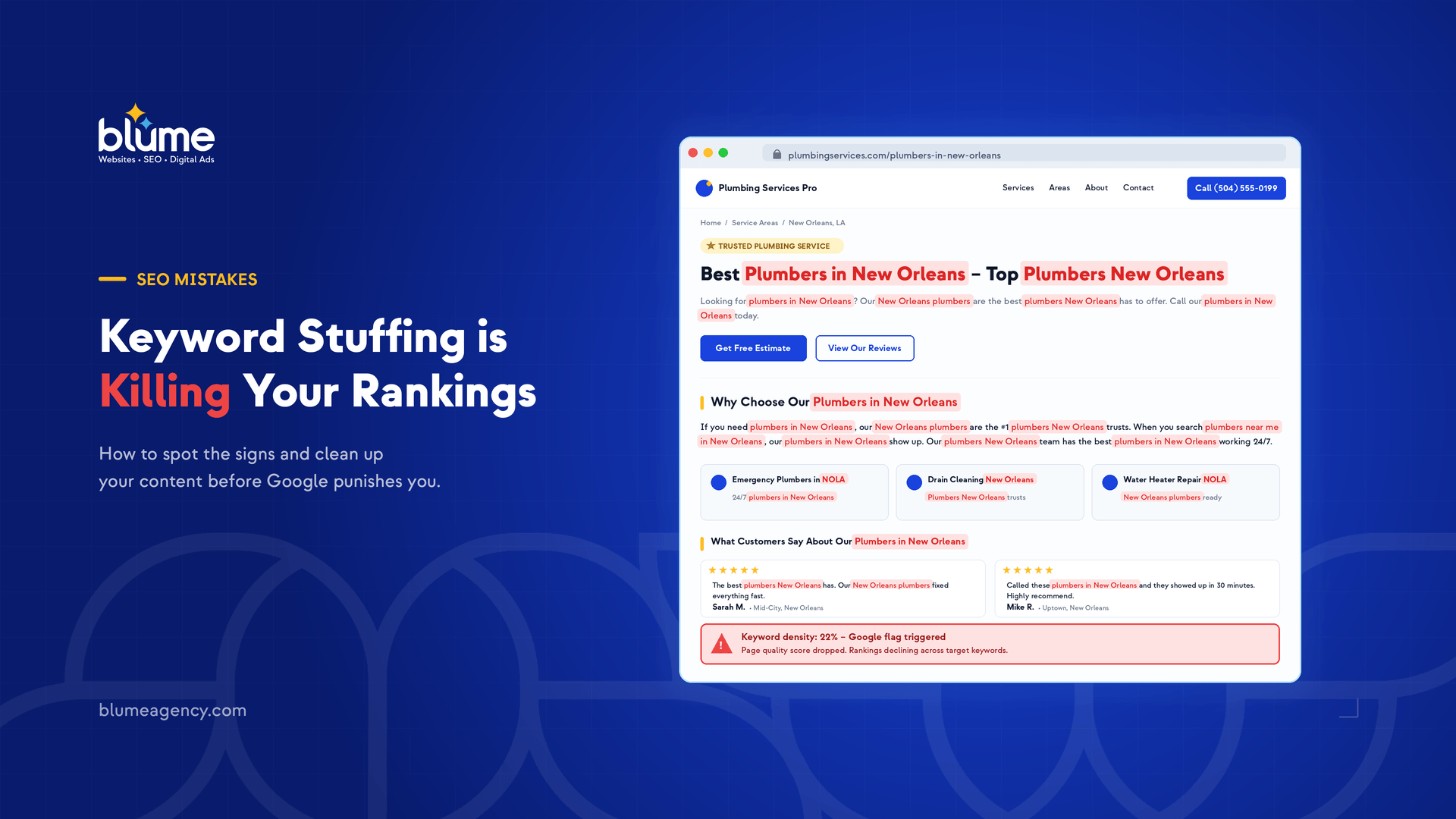
We covered this in depth in a recent post, but it belongs here too because it is one of the most common black hat tactics still being used today. Keyword stuffing means cramming a target phrase into a page so many times that the content becomes unreadable and the only apparent goal is to influence rankings rather than inform a reader.
“Plumber in Houston, Houston plumber, best plumber Houston, Houston plumbing services, plumber near me Houston.” If your page reads anything like that, you have a keyword stuffing problem. Google flags it, the page suffers for it, and customers who actually land on it leave immediately because the content is useless to them.
You can read more about why this damages your rankings in our dedicated post on why you should not stuff your pages with keywords.
Buying Links
This one is worth understanding in detail because it trips up a lot of businesses. Backlinks, which are links from other websites pointing to yours, are one of the most important signals Google uses to determine how authoritative and trustworthy your site is. The more credible sites that link to you, the more Google tends to trust your site.
Black hat practitioners figured this out a long time ago and started selling links. Pay a fee, get a bunch of websites to link to yours, and try to game the authority signal. The problem is that Google has gotten very good at identifying unnatural link patterns. Purchased links from low-quality or irrelevant websites do not fool the algorithm the way they used to. Worse, getting caught with a manipulative link profile can trigger a penalty that tanks your rankings across the board.
According to Google’s link spam policies, buying or selling links that pass ranking credit is a direct violation, regardless of how natural those links are made to look. Google treats this seriously, and so should you.
Cloaking
Cloaking is a tactic where a website shows one version of a page to Google and a completely different version to actual visitors. The version shown to Google is loaded with keywords and optimized content specifically to manipulate rankings. The version shown to real users might be a completely different page, sometimes even a spammy or irrelevant one.
This is a textbook example of trying to deceive a search engine, and Google considers it one of the more serious violations in its guidelines. Sites caught cloaking face severe penalties, and rightfully so.
Hidden Text and Links
Some black hat practitioners hide text on a page by making it the same color as the background, shrinking the font size to nearly zero, or placing it behind images where visitors cannot see it. The hidden text is usually packed with keywords. The idea is that search engines will read it while real users will not.
Google’s crawlers are specifically trained to detect this kind of manipulation. If your website has hidden text built in, whether you put it there or a previous developer did, it is working against you.
Duplicate Content Farms
This tactic involves creating large numbers of pages that are essentially copies of each other with minor wording changes, usually just swapping out a city name or a service type. Some businesses end up with hundreds of these pages on their site, each one barely different from the last, all in an attempt to rank for dozens of locations or keyword variations.
This ties directly into something we talk about often: the difference between a real location page strategy and a lazy one. Genuine Areas We Serve pages have original, useful content written specifically for each location. Duplicate content farms are the black hat version of the same idea, and they do not work. Google identifies the pages as near-duplicates, does not know which one to rank, and often ignores all of them.
If you want to understand how location pages should actually be built, our post on how Areas We Serve pages help you show up in search results walks through exactly what a legitimate local page strategy looks like and why it produces real results.
Private Blog Networks
A private blog network, or PBN, is a collection of websites built for the sole purpose of linking to a target site and artificially inflating its authority. These networks are set up to look like real, independent websites, but they are all controlled by the same person or organization and exist only to pass link value.
Building or using a PBN is one of the more elaborate black hat schemes out there, and it is also one of the riskier ones. Google actively hunts for PBN footprints, and when it identifies them, it devalues the links and often penalizes the sites being linked to as well.
Negative SEO
This is a nastier side of black hat SEO that is worth knowing about. Negative SEO is when someone uses black hat tactics against a competitor’s website to try to get it penalized. This might mean pointing thousands of spammy links at a competitor’s site to make it look like they are buying links, or scraping their content and republishing it all over the web to create duplicate content issues.
Negative SEO attacks do happen, particularly in competitive markets. While Google has gotten better at ignoring suspicious links, monitoring your backlink profile regularly is a smart habit so you can catch and address anything unusual early.
Why Black Hat SEO Is Especially Risky for Service Businesses
For a national e-commerce brand, recovering from a Google penalty is painful but survivable. They have multiple traffic channels, a built-up email list, social media audiences, and other ways to keep revenue flowing while they clean things up.
For a local plumber, HVAC company, or roofing contractor (99% of our clients), Google is often the primary source of new customers. If your website disappears from search results, the phone stops ringing. Period. There is no fallback traffic channel keeping leads coming in while you sort out a penalty.
That makes the stakes of black hat SEO much higher for home service businesses than for larger companies with diversified marketing. A penalty that a national brand absorbs and recovers from over six months could effectively shut down a local contractor’s lead generation for that entire period and potentially, shutter the business.
This is exactly why shortcuts are not worth the risk. The businesses consistently showing up at the top of Google search results in competitive local markets got there through legitimate work done over time, not overnight. They are not going anywhere because their rankings are built on a foundation that Google has no reason to penalize.
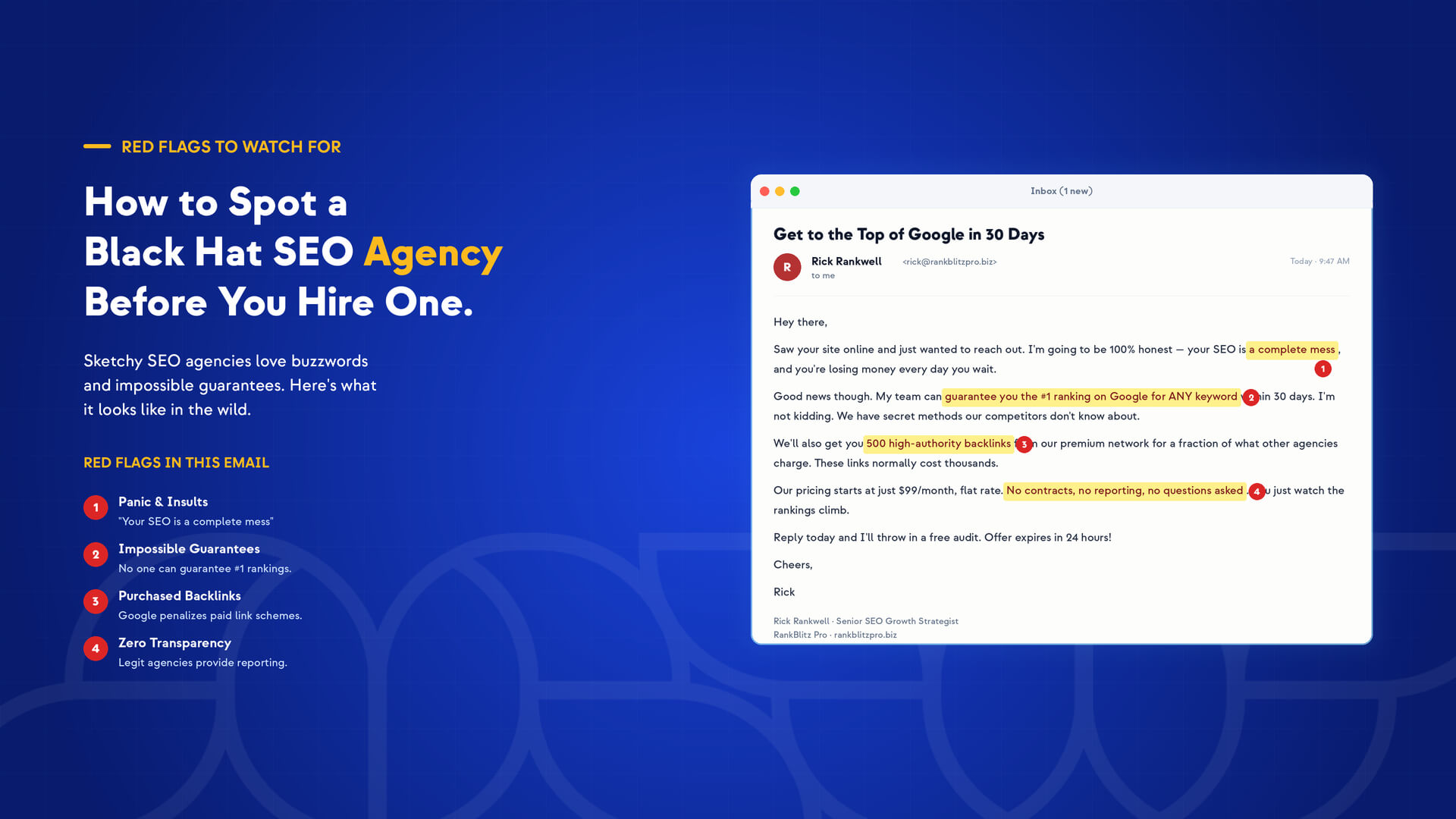
How to Spot a Black Hat SEO Agency Before You Hire One
Not every agency advertising SEO services is running clean tactics. Some are knowingly using black hat methods because those methods can produce fast results that impress clients in the short term. Others are using outdated techniques that used to be acceptable but are now considered manipulative. Either way, the damage ends up on your website.
Here are some things to watch for when evaluating an SEO provider.
They guarantee specific rankings. No legitimate SEO agency guarantees page one rankings or a specific position in Google results. Anyone making that promise is either planning to use black hat tactics or does not understand how SEO works well enough to be trusted with your website. Google’s algorithm involves hundreds of ranking factors and changes constantly. Rankings cannot be guaranteed.
Their pricing seems too low. Real SEO work takes time, skill, and consistent effort. If someone is offering to run your entire SEO for a hundred dollars a month, they are almost certainly automating it with tools that produce low-quality content or links at scale. That kind of work tends to hurt more than it helps.
They do not explain what they are actually doing. A trustworthy SEO partner should be able to tell you in plain terms what work they are performing on your site each month. If an agency is vague about their process or avoids answering direct questions about their tactics, that is a red flag worth taking seriously.
They focus only on rankings without talking about leads. Rankings are a means to an end. The actual goal is more customers calling your business. An agency that talks exclusively about ranking metrics without ever connecting those metrics to real business outcomes may be chasing numbers that do not translate to actual growth for you.
They promise results in a very short timeframe. Legitimate SEO builds momentum over months. A new website in a competitive market is not going to rank on page one in thirty days through clean tactics. Anyone promising otherwise is almost certainly cutting corners.
What Legitimate SEO Actually Looks Like
White hat SEO, which is the term for doing things the right way, is not a mystery. It is a set of practices that take longer to produce results but produce results that last.
It starts with a website that is built correctly from a technical standpoint. That means fast load times, clean code, a logical site structure, and pages that are easy for Google to crawl and understand. A poorly built website is an anchor that keeps even great content from ranking the way it should.
From there, it involves creating genuinely useful content across the right pages. Service pages that clearly explain what you do. A blog that answers real questions your customers are searching for. And critically, dedicated location pages that target the specific cities and towns where your customers are located, each one with original content rather than copy-paste duplicates.
Link building in a legitimate SEO strategy means earning links through real relationships, quality content, and genuine outreach rather than buying them. That process is slower, but those links are far more valuable because Google trusts them.
Finally, it involves consistent monitoring and adjustment over time. SEO is not a one-time project. Rankings shift, algorithm updates roll out, and competitors keep working. Staying competitive in local search requires ongoing attention, which is something Blume provides as part of every ongoing SEO engagement.
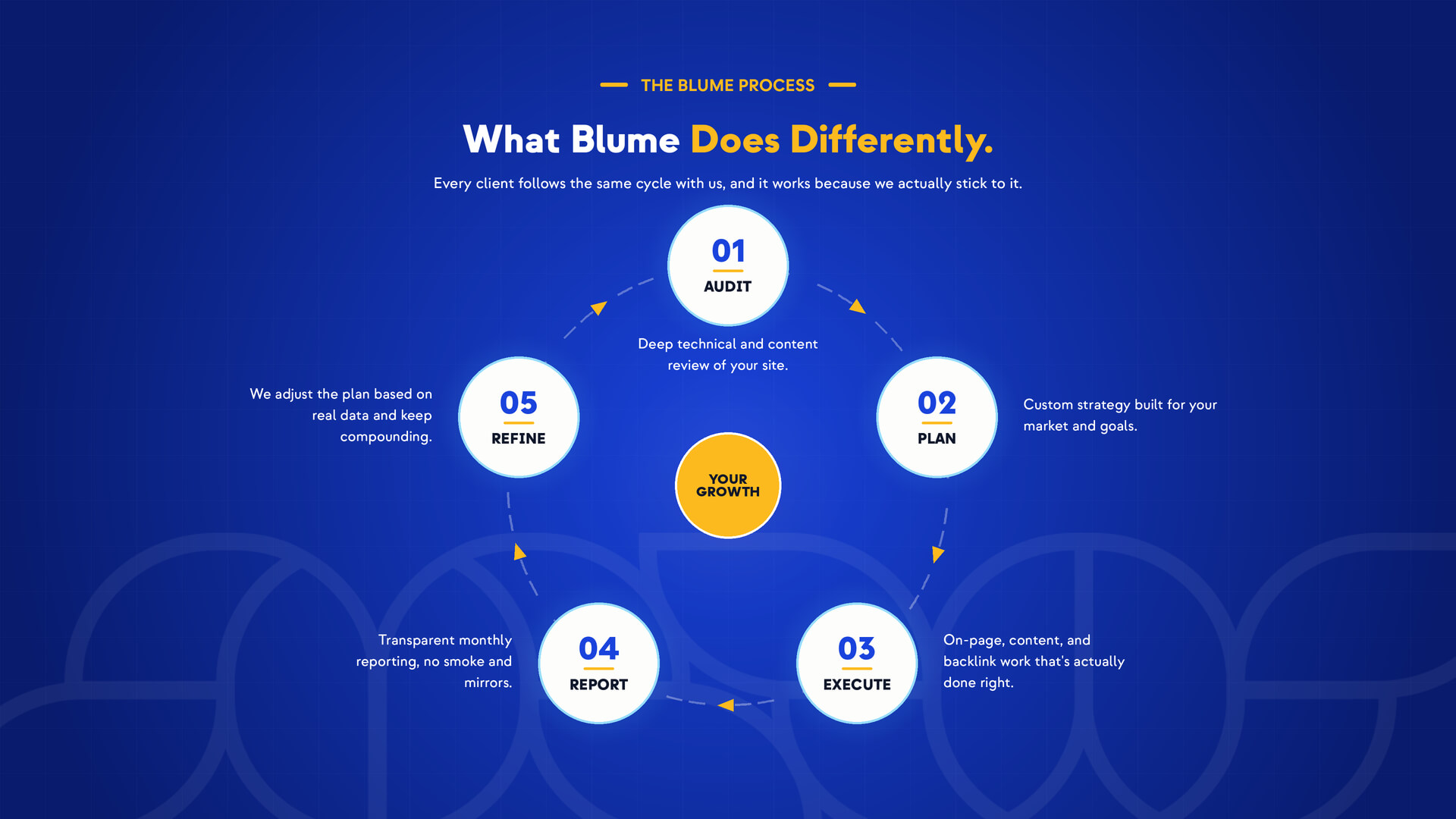
What Blume Does Differently
Blume Agency was built specifically for home service businesses, and every client we take on gets a strategy built on sustainable tactics that are designed to grow over time, not spike fast and crash.
When we build a custom website for a contractor, it is built with technical SEO baked in from day one. Site structure, page speed, mobile performance, and clean code are all part of the foundation, not afterthoughts.
When we build out an SEO strategy, it includes the kind of location page work that actually moves the needle in local search. Each city page is written with original content, optimized for that specific area, and connected to the rest of the site in a way that builds overall authority rather than creating an isolated page that Google ignores.
When we manage Google Ads for a client, we are running campaigns built around real data and real intent, not broad traffic that looks good in a report but does not turn into phone calls.
The results speak to this approach. HUDCO Roofing saw a 190% increase in leads. Paine Excavating saw a 216% lead increase. Duggan’s AC and Heating added more than 220 booked jobs. These are not results that come from cutting corners. They come from doing the work correctly and consistently over time.
Blume works with service businesses across a wide range of markets. You can see the full list of areas on our areas we serve page. And if you want to see which package fits where your business is today, our packages page breaks down the Foundation, Growth, and Expansion options clearly.
FAQ: Black Hat SEO for Service Business Owners
Can my website get penalized even if I did not know my SEO company was using black hat tactics?
Yes. Google penalizes the website, not the agency that built it. If someone you hired used manipulative tactics on your site, your business is the one that suffers the consequences. This is one of the strongest reasons to vet any SEO provider carefully before letting them touch your website.
How do I know if my website has already been penalized?
The clearest sign is a sudden, significant drop in organic traffic or rankings with no clear explanation. You can also check Google Search Console for manual action notices, which Google sends directly when a site has been reviewed and penalized by a real person. If you have not set up Google Search Console for your business, that is something worth doing immediately.
Is it possible to recover from a black hat SEO penalty?
Yes, but it takes real work and real time. Recovery involves identifying and removing the problematic tactics, whether that means rewriting content, disavowing bad links, or cleaning up technical issues. If the penalty was manual, you also need to submit a reconsideration request to Google after the cleanup is complete. The process can take several months, and there is no guarantee of a full recovery.
What is the difference between black hat and gray hat SEO?
Gray hat SEO refers to tactics that exist in a middle ground. They are not explicitly against Google’s guidelines, but they push the boundaries of what is considered legitimate. Things like aggressively pursuing reciprocal link exchanges or using content spinning tools fall into this category. Gray hat tactics carry less immediate risk than outright black hat methods, but they are still not a smart long-term strategy because Google’s guidelines tend to move in one direction over time, and what is gray today often becomes black hat tomorrow.
How long does legitimate SEO take to produce results?
Most businesses start seeing meaningful movement in organic rankings within three to six months of implementing a solid SEO strategy. Competitive markets may take longer. The key point is that results from legitimate SEO build on themselves over time, so the investment keeps paying off the longer you stay with it.
Do black hat tactics ever work long-term?
Rarely, and when they do, it is only a matter of time before they stop. Google updates its algorithm hundreds of times per year, and a significant portion of those updates are specifically aimed at catching manipulation tactics. A business built on black hat rankings is always one update away from losing everything it built.
Why do some SEO agencies still use these tactics if they are so risky?
Mostly because short-term results are easy to sell. A business owner who sees their rankings jump in the first sixty days is happy, and by the time the penalty hits, the agency has already collected several months of fees. Some agencies are also simply operating with outdated knowledge, using tactics that worked years ago without realizing those same tactics are now penalties waiting to happen.
Wrapping It Up
Black hat SEO is a genuine threat to any home service business trying to build a real online presence. The tactics are designed to produce fast results, and sometimes they do, but the cost when Google catches up is almost always worse than the gain was worth. For local contractors and service businesses that depend on Google for new leads, a penalty is not just a marketing setback. It is a direct hit to revenue.
The right approach is straightforward even if it takes longer. Build a solid website. Create useful content. Target local searches with dedicated location pages rather than cramming city names onto a single page. Earn links through legitimate means. Stay consistent over time.
That is what Blume Agency does for home service businesses every single day. No shortcuts, no tricks, no tactics that put your rankings at risk. Just real work that produces real growth and keeps producing it month after month.
If you want a partner who is going to do this the right way for your business, we are ready to talk. Let’s Blume.